Bedding • Sleep comfort
Inside Innerspring Mattresses: How Coil Design Shapes Support and Airflow
Beneath the familiar surface of an innerspring mattress lies a carefully arranged field of metal coils. Their shape, layout, and connections influence how the bed responds to weight, how motion travels, and how air can move through its interior. Understanding those details—alongside the padding above and the base below—can make mattress comparisons clearer and help you choose a sleep setup that suits your needs.
Published November 10, 2026
A support system hidden in plain sight
An innerspring mattress is built around a core of metal springs, often called coils. The springs compress under load and push back as the load changes. That basic exchange gives the mattress its characteristic responsiveness: pressure is met with resistance, and the surface tends to recover its shape after movement.
But “innerspring” describes a family of constructions, not one uniform design. Coils differ in shape, thickness, number, arrangement, and whether they are linked together or enclosed individually in fabric pockets. Padding, upholstery, the mattress cover, and the bed foundation all contribute to the final feel. A mattress that appears to have a similar spring count to another may perform differently because the coils are configured differently—or because the materials above them change how their response reaches the sleeper.
It helps to think of the mattress as a layered landscape. The coil unit is the underlying terrain, distributing and resisting weight. Comfort layers are the softer ground above it, shaping how the body meets that terrain. Neither part tells the whole story on its own. A good comparison considers how they work together.
The main coil configurations
Several broad coil designs appear in innerspring mattresses. Product names and specifications vary, so the most useful approach is to ask how a construction is arranged and what that arrangement is intended to do, rather than assuming that a label guarantees a particular experience.
Bonnell and other interconnected coils
Bonnell coils have an hourglass-like form and are commonly connected by wire into a coordinated spring unit. Because neighbouring coils are linked, pressure in one area can influence nearby springs. This shared response can create a familiar, springy feel, but it may also allow movement to travel across more of the mattress surface.
Other continuous or interconnected designs use variations on this principle. Their structure can provide a stable, responsive support core, though the degree of motion transfer depends on the exact coil arrangement, the padding, and how firmly the unit is anchored at its edges. A linked system should not automatically be considered uncomfortable; comfort depends on the whole build and on the person using it.
Pocketed coils
In a pocket-coil mattress, each coil is wrapped in its own fabric sleeve. The pockets allow springs to respond more independently than coils joined directly by a continuous wire. That individual movement may help the surface adapt to uneven pressure and limit some movement travelling from one side of a bed to another.
Independent coils do not guarantee complete motion isolation. The springs still sit within a shared mattress, and comfort layers, edge construction, and the bed frame can affect how a movement is felt. Still, pocketing offers a useful design distinction, particularly for people who share a bed and want to compare how much motion reaches the other side.
Offset and related designs
Offset coils use shaped, often hourglass-like springs arranged so their turns can connect or hinge at contact points. This can create a more coordinated unit with a different pattern of compression and response from traditional Bonnell arrangements. Other variants modify the spring geometry or the way coils are joined to adjust firmness, flexibility, or stability.
Names alone are not a reliable measure of quality. Coil gauge, the number and placement of springs, the quality of the surrounding materials, and construction details all matter. When specifications are available, they are best treated as clues to investigate—not as a simple scorecard.
How coil design shapes support
Support is often described as whether a mattress keeps the body comfortably aligned. In practical terms, the surface needs to respond to the body without letting heavier areas sink excessively or leaving lighter areas unsupported. A coil system contributes by resisting compression, but its result depends on where the body places pressure and how the upper layers distribute it.
When a person lies down, the mattress compresses by different amounts in different places. Shoulders and hips may exert more concentrated pressure than the waist or legs. A suitable sleep surface allows those areas to settle enough for comfort while maintaining a supportive response elsewhere. The term “firm” describes an overall impression, not a complete account of how the mattress supports different parts of the body.
Coil spacing and configuration can influence how the spring core responds across the surface. Individually pocketed coils may respond more locally, while interconnected systems may spread some force across neighbouring springs. The height and shape of each coil, as well as its resistance to compression, further affect the feel. Above the core, padding can soften the first contact or change how quickly the sleeper feels the spring response.
There is no universally correct firmness for every person. Body shape, sleep position, comfort preference, and any existing pain or medical considerations can influence what feels appropriate. Side sleepers often look for enough give around the shoulder and hip, while people who sleep on their back or stomach may prefer a surface that feels more level. These are general tendencies, not rules. Personal comfort and alignment matter more than a label printed on a showroom tag.
For a thoughtful trial, notice more than the immediate softness. Lie in your usual sleep position long enough to assess whether pressure builds, whether your torso feels supported, and whether changing positions is easy. If you share the bed, test it together where possible: one person’s comfort and movement can affect the other’s experience.
Airflow, temperature, and the materials around the coils
The open spaces between springs can give an innerspring core pathways for air movement. When a sleeper shifts position, air within and around the mattress may move as well. This feature can contribute to a less enclosed construction than some dense, solid foam cores, but it does not by itself determine whether a mattress will feel cool.
Airflow is only one part of the temperature picture. The materials above the coils can either allow heat and moisture to move away from the body or create a more insulating surface. The mattress cover, quilting, foam layers, natural fibres, and even the sheets all influence the sensation of warmth. Room temperature, humidity, sleepwear, and an individual’s own tendency to feel hot or cold also play significant roles.
Some mattresses include side vents or other features intended to encourage air exchange. These may support circulation through the mattress, but their presence is not a guarantee of a particular sleep temperature. Ask how the entire construction is designed, and look for clear information about the comfort layers and cover as well as the coil unit.
Natural fibres such as wool and cotton may absorb and release moisture differently from synthetic materials, while foams vary in density and structure. None should be treated as an automatic promise of cooler sleep. A useful comparison focuses on the complete materials list and on how the mattress feels during an extended, realistic trial.
Motion transfer and sharing a bed
When one sleeper turns, gets up, or changes position, the movement can travel across a mattress. How noticeable it is depends on the coil configuration, the size and direction of the movement, and the layers surrounding the springs. Linked coils may transmit motion through their connections, while pocketed coils can respond more locally. Comfort layers may absorb some movement before it reaches a partner.
Motion transfer is not always a drawback. A more responsive surface can make it easier to change position and may feel lively to some sleepers. The priority depends on the household: a person who wakes easily may place greater value on limiting movement, while another may prefer the buoyant feel of a more connected spring system.
Couples should test the mattress from both sides. Take turns shifting position while the other person lies still, and consider the effect of getting in and out of bed. A split-firmness option, where available, can address different comfort preferences on each side, though the joining point and shared base still deserve attention.
The comfort layers make the first impression
Most sleepers do not feel the coils directly. Padding lies between the spring unit and the body, changing the mattress’s surface feel and how pressure reaches the support core. Depending on its materials and thickness, this layer may feel plush, resilient, or firm. It can also affect how quickly the sleeper senses the coils beneath.
More cushioning is not automatically better. A thick, soft comfort layer may feel inviting at first but can produce a sense of excessive sink for some people. A thinner or firmer layer may let the spring response come through more clearly. The right balance depends on the sleeper’s preferred feel and whether the mattress maintains comfortable support in their usual position.
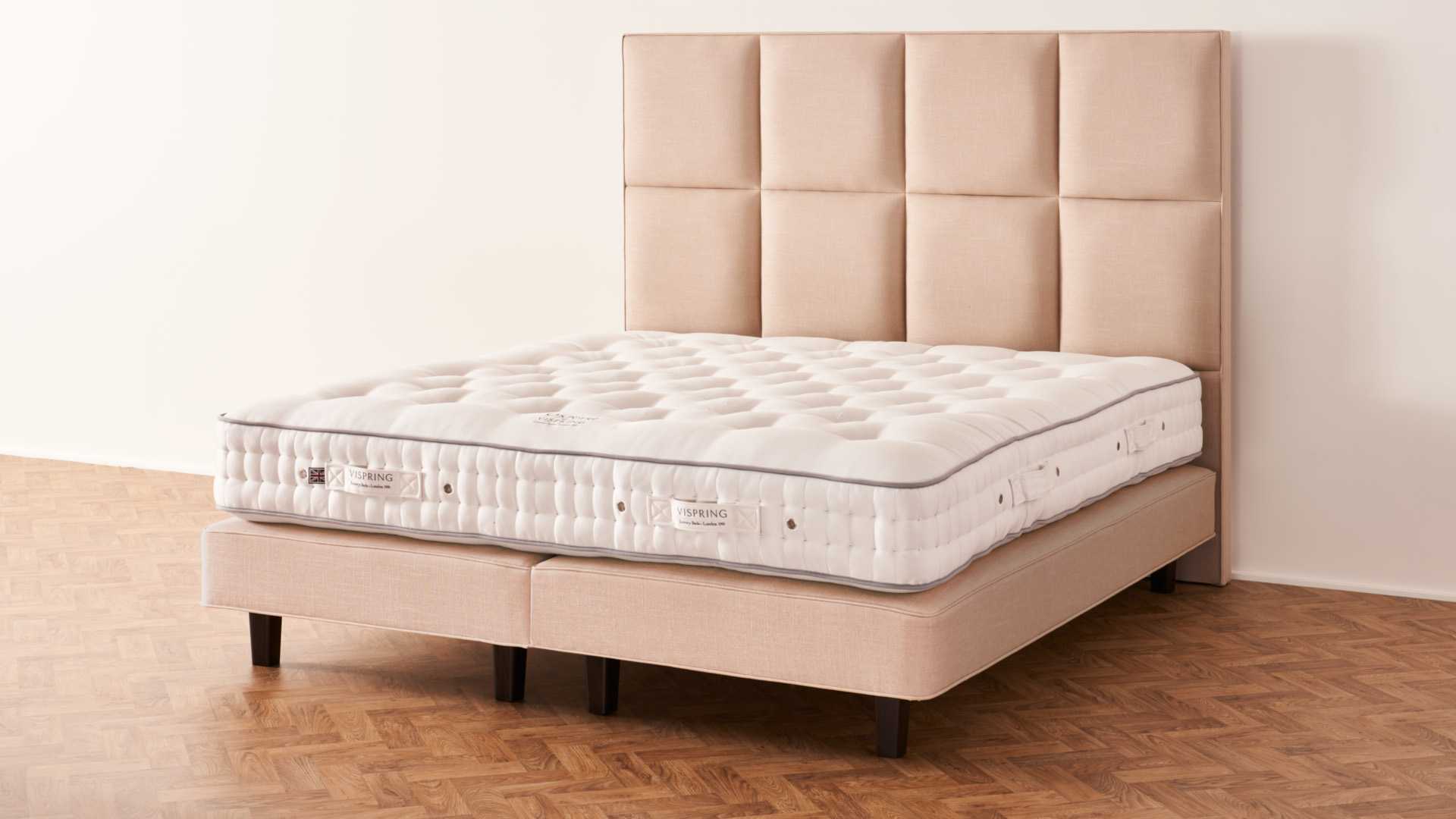
As one example of a spring-and-fibre construction, the Vispring Devonshire uses a single tier of individually pocketed coils with layers of British fleece wool and a wool-and-viscose cover. Its stated construction illustrates why a mattress should be evaluated as a system: the spring unit and the materials around it both shape the experience. Product specifications are not a substitute for assessing fit and comfort in person.
A practical checklist for comparing mattresses
Retail descriptions can contain unfamiliar terminology and impressive-sounding numbers. Use a few consistent questions to compare the essentials and keep the focus on the sleep experience you want.
- What kind of coil system does it use? Ask whether the coils are linked, pocketed, continuous, or arranged in another configuration.
- How does it feel in your usual position? Test pressure around the shoulders and hips, and notice whether your body feels comfortably supported.
- How much motion reaches a partner? Try gentle movements on each side and assess whether the mattress response suits both sleepers.
- What materials sit above the coils? Compare the padding, cover, and any natural or synthetic fibres—not just the spring specifications.
- What does the edge feel like? Sit and lie near the perimeter. Edge support can affect the usable sleep surface and ease of getting in and out.
- What is the trial and return policy? A brief showroom test may not reveal how a mattress feels over time. Understand the conditions before purchase.
- What care does it require? Check turning or rotation advice, cleaning instructions, and warranty terms. Follow the manufacturer’s guidance.
Comparisons are most useful when the testing conditions are similar. Try mattresses with the same pillow and in the same sleeping position when possible. If you are comparing several options, jot down what you notice rather than relying on a quick impression that may blur together after a long showroom visit.
Fit with the bed base matters
A mattress performs on a foundation, so check that the base provides the kind of support the manufacturer requires. Slat spacing, a platform surface, a box foundation, or an adjustable base can each affect compatibility. An unsuitable or uneven base may undermine support, contribute to premature wear, or create a feel different from the one expected.
Adjustable bases need particular attention. A mattress used on one must be flexible enough to move with the base, and the mattress maker should confirm compatibility. The base’s movement changes the mattress position, but it does not replace the mattress’s own support system. Consider how the mattress bends and whether its construction is approved for the intended setup.
Measure the bed frame and mattress carefully, including height and depth. Check that fitted sheets will accommodate the finished profile, especially when adding a topper or protector. A well-matched set of components makes day-to-day use easier and can help preserve the intended fit.
Care, durability, and realistic expectations
Coils are designed to compress repeatedly, but durability depends on the entire mattress and how it is used. Spring material, construction quality, upholstery, edge reinforcement, and the foundation all play a part. A high coil count alone cannot predict how long a mattress will remain comfortable, and a warranty does not necessarily promise that the mattress will feel unchanged for its full term.
Follow the care instructions supplied with the mattress. Some models can be rotated to distribute wear; others have a designated top and should not be flipped. Keep the mattress on a suitable base, use a protector if appropriate, and address spills according to the manufacturer’s directions. Avoid bending or folding a mattress unless the maker specifically permits it.
Over time, the surface may change as comfort materials settle or compress. Pay attention to persistent dips, unevenness, or a loss of support that affects rest. If discomfort is persistent or connected to a health concern, a mattress change may not be the only consideration; a qualified health professional can provide appropriate guidance.
Beyond the coil count
Coil count can be informative when it is presented alongside other specifications, but it is not a stand-alone measure of comfort or quality. Counts may vary with mattress size, and manufacturers may describe their spring units differently. Coil shape, gauge, zoning, pocketing, and the amount and type of cushioning all influence how a mattress feels.
Similarly, terms such as “orthopedic,” “cooling,” or “pressure relieving” should prompt questions about what the claim means in practical terms. Look for details about construction, test the mattress under realistic conditions, and read the trial and warranty provisions carefully. Clear, specific information is more useful than broad promises.
The most informed choice is not necessarily the most complex or expensive mattress. It is the one whose construction, feel, care requirements, and base compatibility align with your sleep preferences and circumstances.
A considered choice for nightly comfort
An innerspring mattress is a meeting point between mechanics and material: coils resist and recover, padding softens or sharpens their response, and the cover and surrounding construction influence airflow and feel. The same design detail can matter differently from one sleeper to another. Pocketed springs may appeal to people comparing motion transfer; a more connected unit may suit someone who likes a lively, coordinated response. Neither description can replace a careful test.
Start with your everyday needs. Think about your usual position, whether you share the bed, how warm you tend to feel, and what kind of surface feels comfortable. Then compare coil design, comfort layers, mattress dimensions, care guidance, and base compatibility as parts of one setup. The aim is not to decode every technical term, but to understand enough of the construction to make a confident, informed decision.